Augere · Standards
The Farm Decision Model Standard.
FDMS version 1.2, the adopted edition, in force from 5 August 2026. A citable statement of what every agricultural decision model must contain and when each requirement applies: sixteen elements in three conformance classes, twenty-nine binary triggers, and two claims a model may make. Free to use and free to cite, for consultants, funders, lenders, cooperatives and programmes.
Why a standard
The market has stopped paying for reports and started paying for models: working machinery that lets a decision-maker walk a choice forward under different assumptions. But while the profession teaches how to build models, there has been no common statement of what a farm decision model must contain to be trusted, nor of when each requirement applies. FDMS closes that gap. It is a test, not a textbook: hold any model against the sixteen elements, answer the triggers, and the record says what is missing. The one-sentence test at its heart: if a person who did not build it can change an assumption and watch the decision change, it is a decision model; otherwise it is a document.
How conformance works
Every element carries one of three classes. Core elements are required in every model: depth is proportionate to the decision, presence is not negotiable. Conditional elements are governed by twenty-nine binary triggers: any single Yes activates the element, every trigger must be answered, and where all of an element's triggers are No the model carries a recorded non-applicability statement, so silent omission does not exist. Two claims are defined, and anyone may use either, free and without permission: Conforms to FDMS 1.2 (everything passes, everything recorded) and Assessed against FDMS 1.2 (the record is complete and published, with any failures disclosed; an honest disclosure, not a lesser grade).
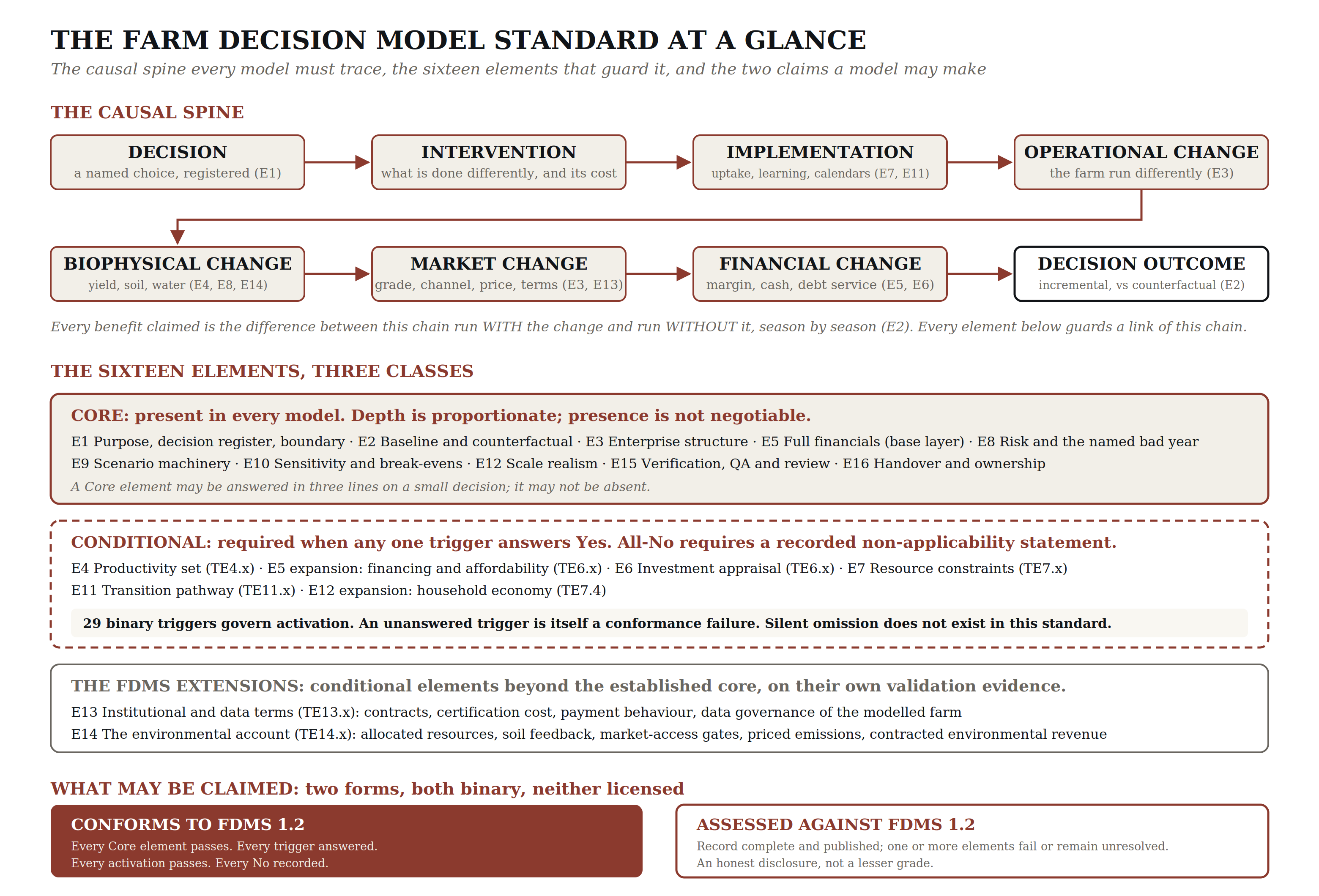
The sixteen elements
1. Purpose, decision register and boundary
Names the decisions the model serves and its boundary; every output traces to one.
2. Baseline and counterfactual
The without-change case as a trajectory, not a photograph; every benefit is incremental.
3. Enterprise structure
The farm as it is; revenue traced grade by grade at realised prices.
4. The productivity set
Returns per hectare, labour day, cubic metre, unit of capital; not yield alone.
5. Full financials
Margins to monthly cashflow to balance sheet, linked; owned resources priced.
6. Capital and investment appraisal
NPV, IRR, payback, financing inside the cashflow, on incremental flows.
7. Resource constraints
Labour, land, water, machinery as calendars, not costs.
8. Risk and uncertainty
Ranges, and the bad year modelled by name.
9. Scenario machinery
Shocks the user can run without touching a formula.
10. Sensitivity discipline
The three assumptions that matter, with break-even values.
11. The transition pathway
Season by season, partial uptake, learning curves, the named stop rule.
12. Household and scale realism
The plan must survive contact with two hectares, per household per month.
13. Institutional and data terms
Who pays, when, with what record; what compliance really costs; who holds the data and on what terms.
14. The environmental account
Allocated resources, soil feedback, market-access gates, priced emissions, contracted environmental revenue.
15. Verification, quality assurance and review
The QA record lives in the model; assumptions registered with source, date, owner.
16. Handover and ownership
Assumptions open, client-runnable; the consultant leaves, the machinery stays.
Use it in a terms of reference
One line does it: "The deliverable model will be assessed against FDMS 1.2, and the conformance record will be completed in full: every Core element passed, every trigger answered with evidence, every non-activated Conditional element carrying a recorded non-applicability statement." The standard includes the conformance record for exactly that purpose. Anyone may use either claim for any model without licence; the standard asks only to be cited: Mambozoukuni, J. (2026). The Farm Decision Model Standard, Version 1.2. Augere / Auctus Agri.
How version 1.2 was validated before adoption
Adoption followed a three-part validation programme, run in public and documented in the standard. The conformance classes derive from coded evidence across fifteen institutional and peer-reviewed sources; the authored institutional and environmental triggers were independently expert-validated against published law, systematic reviews and appraisal frameworks; trigger burden was calibrated on paired demonstration cases (a maximum-complexity smallholder transition activating nearly all triggers, a deliberately simple commercial rate decision activating four of twenty-nine); and every element is demonstrated in a reference workbook a client can own. Nothing is required by this standard that has not been built in a spreadsheet. Version 1.0 remains archived as the prior edition. Comments to standard@auctusagri.com are credited in future editions.
The public record
FDMS is maintained in public. The adopted edition is frozen under a published change-control rule; every comment received is answered in a published disposition record; every change candidate is logged in a versioned change register; and the standard’s calibration, including the defects it caught in its own author’s work, is published in a signed register. The first amendment cycle is open now: comments close 30 November 2026, and edition v1.3 enters force on 1 February 2027. Models claiming conformance to v1.2 are accepted until 1 February 2028.
The twenty-nine-trigger register was calibrated on two deliberately contrasted cases: a maximum-complexity smallholder transition activating twenty-five of twenty-nine triggers, and a minimal commercial maize decision activating four. The signed register records every answer with its evidentiary basis, and its defect log records the error the register’s own discipline caught in the author’s work, disclosed and corrected in public rather than repaired silently. Read the Case B summary for the short version.
The strongest test available to a conformance instrument is application by someone who is not its author. The standard, the reference workbook and the signed calibration register are public, so that test requires no cooperation from the author. If you apply FDMS to a model of yours, or reconstruct a case from the published record, write to standard@auctusagri.com: the change register has a lane for what you find.
The record, direct downloads, no form: Signed Calibration Register v1.0 (PDF) · the register spreadsheet, artefact of record (XLSX) · Calibration Case B summary (PDF) · Comment Disposition Record No. 1 (PDF) · Change Register v1.2 (XLSX) · Erratum Notice No. 1 (PDF)
Download the standard and the reference workbook
Two artifacts, both free: the full standard (Augere Working Paper 2026-01, revised: sixteen elements with pass tests, common failures and evidence bases, the twenty-nine-trigger register, and the conformance record) and the reference workbook, a complete worked implementation with its quality-assurance record and trigger answers, built to be owned. Proposed amendments are welcome at standard@auctusagri.com and are credited in the next version.